US military actions: An unchecked exercise of power
TEHRAN — They say the future is not singular, but plural. This is the first lesson we were forced to learn in the days of war: a future that is the byproduct of the actors' deeds; an assemblage of probabilities resulting from the superposition of daily affairs; an accumulation that only abstract thought, or perhaps someone tethered to a metaphysical reference, can perceive as a whole.
It is this very quality, its improbability and its perceived disconnection from the present, that has captivated humanity throughout history with the lure of soothsayers.
Those who claimed knowledge of the future, whether through truth or deception, were always revered.
In these times, the greatest soothsayer is Artificial Intelligence. I ask it: "What is the future of this war?"
It tells me this conflict bears a striking resemblance to the Yugoslav Wars, and its endgame is civil war and disintegration.
I do not want to believe it. I want to reject this probability; why must I surrender to such a future? I ask: "Tell me the other probabilities, the other futures."
Its propositions become nonsensical, resembling a blurred composite of several overlapping photographs.
Perhaps the primary flaw is Trump himself. Even AI fails to grasp his behavior. From day one, he adopted a stance of "strategic ambiguity."
Every option remains on the table, and each one constructs a different future: a ground invasion; the occupation of the Iranian islands; the annihilation of Kharg, Iran’s primary oil terminal; or special forces sent to extract enriched uranium from beneath the rubble of an eight-month-old bombardment. Each path carries its own hypothetical destiny.
It is not only we who, amidst this ambiguity and indeterminate future, seek out palm readers and sorcerers; the politicians are equally bewildered.
Perhaps this is an issue the European citizen feels distanced from. Perhaps you believe this war has nothing to do with you. You might be right, for now.
But the collapse of a predictable future concerns you deeply. How one is permitted to think about the future is one's business as well.
Now that the war has claimed more civilian lives than military ones, now that they came in the name of "saving the people" only to kill them, it is time for you to consider this: after so much inversion of truth and doublespeak, what will you do when you can no longer predict the future and everything for you is decided in a fog of uncertainty?
For nearly eighty years after World War II, we lived within a predictable world order, a system born from humanity’s reflection on its own behavior and the philosophy that emerged after two great slaughters.
Since then, there have been wars: Korea, Vietnam, Yugoslavia, the Persian Gulf, Syria, and Libya. Each was waged under the pretext of that very order, ostensibly built upon the human rights of nations.
But this new war, launched by the US and Israel against Iran without a UN mandate, without a clear future, and without the support of traditional allies, is designed to dismantle that former order.
It seeks to render the future indeterminate; to create chaos in the hope that a new disorder will emerge that favors American supremacy, as the old order no longer guarantees its hegemony.
Perhaps you are indifferent today. Perhaps you believe the Iranian government is "evil," that it has "killed its own people" and "deserves this fate."
This pretext is no more convincing than "weapons of mass destruction" or "atomic bombs," yet thus far, it has faced little resistance. From here on, however, the war has targeted our very lives.
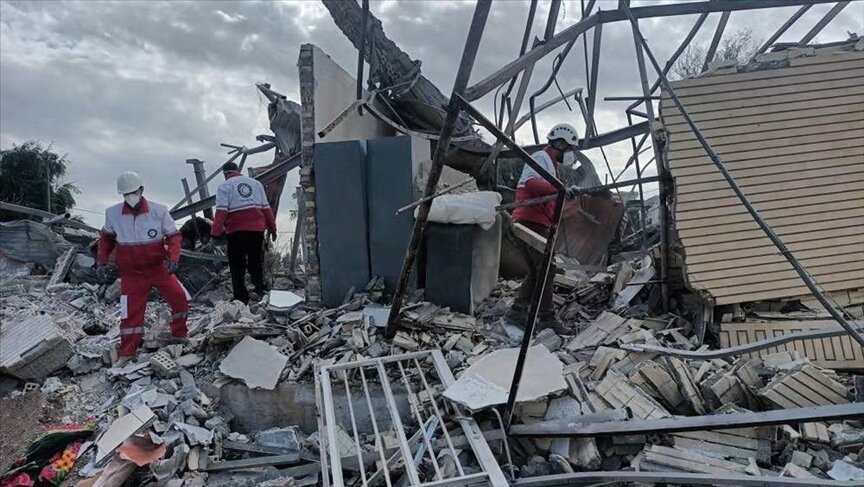
Recently, I stood at the site of immense destruction in an eastern neighborhood of Tehran. Buildings that, contrary to the claims of military spokespersons, were leveled with imprecise bombs.
Hundreds of civilians were killed or wounded; nearly half were women and children. Cars were crumpled like paper. Wardrobes were shattered, their contents spilled into the dirt. Children’s storybooks lay scattered, page by page, across the street.
Restaurant delivery riders spoke of bringing food to these homes only recently. One mentioned that a resident was his friend’s wife; they had been married for only a month.
I could not cry. My emotions had been scorched dry. The scale of the ruin, shattered windows blocks away, collapsed walls, denied me the luxury of feeling.
I heard those explosions every day; I saw the pillars of smoke daily. But until that moment, the war had been an abstraction.
No "strategic ambiguity" justifies those scenes. No politician has the right, simply because they possess the power to attack, to do so without the consent of the United Nations and the global community.
Trump feels no need for authorization from anyone, not the US Congress, and certainly not the advisory opinions of think tanks. Whoever holds the strongest lobby and can guarantee the highest probability of profit can wage war through him.
After Iran, the target is Cuba; then, Greenland. As a European, you will soon taste the flavor of "strategic ambiguity" if you do not protest it today.
Leave a Comment